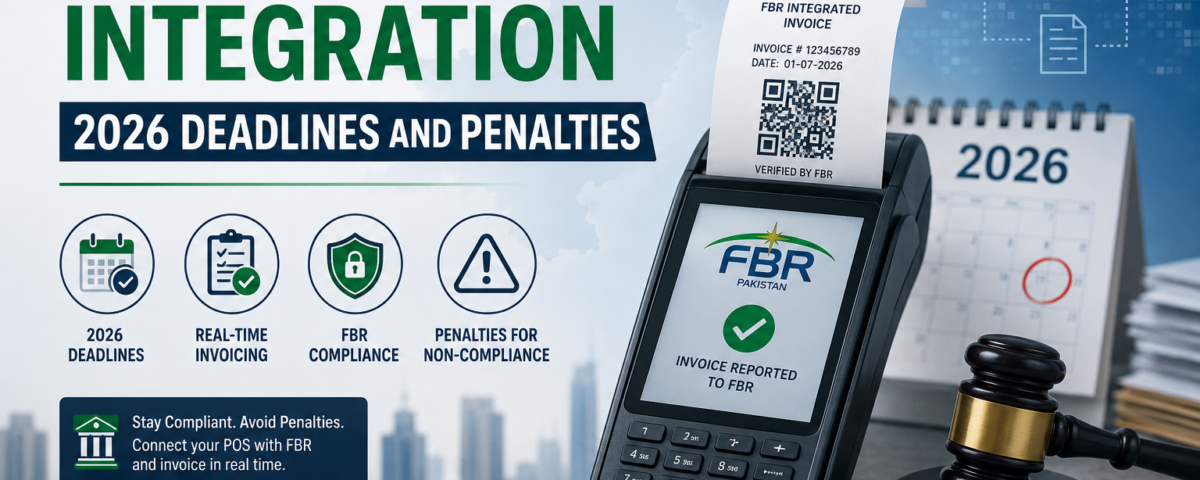
If you run a retail outlet, restaurant, salon, or clinic in Pakistan, 2026 has brought a wave of regulatory change that’s hard to ignore. FBR POS Integration is now a key compliance requirement for an expanding range of businesses across the country. The Federal Board of Revenue has widened its net for businesses required to connect their point-of-sale systems to its central database, and the timeline for doing so is tightening. This year isn’t just about another notification sitting in an inbox. It marks a shift toward real enforcement, with penalties, audits, and even business restrictions on the table for those who delay.
Understanding what’s changing matters more than reacting to headlines. This blog breaks down the current POS compliance requirements, which sectors are newly affected, what the 2026 deadlines actually look like, and what penalties apply when a business falls behind.
What FBR POS Integration Means in 2026
FBR POS integration connects a business’s billing system directly to FBR’s servers, so every sale gets reported in real time through a secure API. Each invoice carries a unique number and a QR code that customers can scan to confirm the sale was recorded. This isn’t a new concept, but SRO 288(I)/2026 rewrote large parts of the rulebook, expanding who must comply and tightening how compliance is checked.
The update also introduces stricter recordkeeping. Businesses may need to preserve transaction data and, under certain draft provisions, retain premises footage for verification during compliance checks. The direction is consistent: FBR wants a documented, verifiable trail for every transaction.
Who Falls Under the Newly Notified Categories
One of the biggest shifts in 2026 is scope. Categories that previously sat outside mandatory integration are now included. This affects hotels, guesthouses, marriage halls, private clubs, courier and cargo operators, and intercity transport. It also reaches into personal care and medical services, including beauty parlours and salons, slimming centres, dental and private clinics, diagnostic laboratories, and health clubs.
This matters because many of these businesses previously assumed integration only applied to large retailers or textile sellers. That assumption no longer holds, and understanding why digital invoicing is mandatory makes it easier to see why the net keeps widening. If your business falls into any notified category, working out where you stand on the compliance timeline should be a near-term priority, not something to defer until a notice arrives.
The 2026 Compliance Timeline
FBR’s rollout for 2026 has moved in stages rather than a single cutoff date. A few markers stand out:
- Draft amendments under SRO 288(I)/2026 were issued in February 2026, expanding notified categories for public feedback.
- Digital invoicing enforcement tightened through mid-2026, with heavier scrutiny on businesses still issuing invoices outside FBR’s system.
- The Finance Act 2026 took effect on July 1, 2026, amending Inland Revenue laws and moving FBR toward a fully faceless tax administration.
- A Faceless Inland Revenue Center is expected to become operational by October 1, 2026, which is likely to sharpen enforcement further.
Because rules have been introduced in phases, the safest approach is treating every notification as provisional until FBR issues final gazetted rules. The full text of the Finance Act 2026 is available on the Ministry of Finance website for anyone who wants to verify the provisions directly, but the practical takeaway is the same: prepare systems well ahead of any confirmed date.
Penalties for Non-Compliance
This is the part most businesses want a straight answer on, and the direction from FBR is unambiguous. Non-compliance is no longer treated as a minor administrative gap.
- Invoices issued outside the integrated system may be treated as legally invalid.
- Non-compliant businesses risk monetary penalties under Section 182 of the Income Tax Ordinance and provisions of the Sales Tax Act, 1990.
- Customers linked to non-compliant sales may lose input tax adjustment, which damages business relationships beyond the immediate penalty.
- Repeated violations can trigger audits, business restrictions, or enforcement visits.
FBR has also indicated plans to deploy enforcement squads to verify real-time compliance at business premises, rather than relying solely on desk audits.
For businesses that want to understand FBR’s POS integration requirements, invoice validation process, and technical specifications in more detail, they can review the official FBR POS Integration FAQs.
Why Enforcement Is Different This Time
Earlier phases of POS integration relied heavily on self-reporting and incentives, such as reduced sales tax rates for early adopters. That approach produced only partial coverage. The 2026 changes reflect a different posture, backed by expanded enforcement staff and infrastructure. FBR has also worked to clarify how provincial tax authorities differ from federal integration requirements, since businesses operating across provinces sometimes face separate obligations to bodies like KPRA or SRB alongside FBR.
Combined with faceless administration, this signals that the era of quiet non-compliance is closing. Businesses that integrate early are less likely to face disruption when enforcement scales up.
Preparing Your Business Before the Deadline
A few practical steps make the transition manageable rather than rushed:
- Confirm whether your business sector falls under a newly notified category.
- Register for sales tax with FBR if you haven’t already.
- Choose a POS system built for real-time invoice reporting, rather than retrofitting one later.
- Brief your team on the reporting requirements so they understand the reasoning, not just the mechanics.
- Keep records organized in case of an enforcement visit or audit request.
Businesses that treat this as routine operational upkeep, rather than a last-minute scramble, tend to avoid the penalties tied to rushed or incomplete integration.
myPOS has worked with retail, salon, and hospitality businesses across Pakistan to align POS setups with FBR’s evolving requirements. Our FBR Digital Invoicing Software connects your billing directly to FBR through PRAL, so every invoice is verified in real time without extra work at the counter.
Final Thoughts
FBR’s 2026 changes widen who must comply and raise the cost of falling behind. The safest position for any notified business is early, verified integration rather than waiting for a deadline notice to force the issue. Reviewing your digital invoicing setup now, before enforcement scales further, is a far lighter lift than responding to a penalty later, and our FBR compliance guide is a practical place to start if your team is handling the registration and testing process internally.
Frequently Asked Questions
Is FBR POS integration mandatory for all businesses in 2026?
It’s mandatory for sales-tax-registered businesses and a growing list of notified sectors, not every business universally.
What happens if my invoices are issued outside FBR’s system?
They may be considered legally invalid, and customers linked to them can lose input tax adjustment.
Do salons and clinics need to integrate now?
Yes, beauty parlours, clinics, and similar personal care or medical services are among the newly notified categories.
Is there a fee to integrate with FBR directly?
No, FBR doesn’t charge a fee for integration itself, though POS setup and integrator configuration costs may apply.
When does the faceless tax administration model take effect?
The Finance Act 2026 took effect on July 1, 2026, with the Faceless Inland Revenue Center expected around October 2026.
Get your business on myPOS — free demo, FBR-ready.
Our team sets up the POS, FBR / PRA integration and staff training for you. Most businesses are live within 1–3 days.